Chasing Light in Paradise: Guam’s Wild Beauty Through My Lens
You know what? I never expected Guam to be *this* photogenic. Beyond the resorts and cruise ships, I found raw, untouched landscapes—crystal-clear coves, jungle-clad cliffs, and sunsets that look photoshopped (but aren’t). If you're chasing natural beauty with your camera, this island is a dream. Let me show you the real side of Guam, where every frame feels like a postcard come to life. This isn’t just another tropical postcard destination; it’s a living canvas painted with light, texture, and motion. For photographers seeking authenticity, Guam offers a rare blend of accessibility and wildness—a place where nature still breathes freely, and every sunrise promises a new composition.
The Island That Stole My Lens
When most travelers think of Guam, they picture white-sand beaches lined with luxury resorts, duty-free shopping, and the steady rhythm of cruise ship arrivals. But step beyond the tourist hubs of Tumon and Hagåtña, and a different Guam emerges—one shaped by volcanic ridges, limestone plateaus, and centuries-old forests. This is an island of contrasts: modern infrastructure meets ancient Chamorro culture, and coastal calm gives way to inland wildness. As a photographer, I came expecting pleasant scenery. What I discovered was a landscape so visually rich it demanded a full recalibration of my lens settings—and my expectations.
From the moment I landed, the quality of light struck me. It wasn’t just bright; it was layered. Morning rays cut sharply across the runway, highlighting the deep green of mangrove stands along the coast. By midday, the sky turned a pale, almost metallic blue, casting strong shadows that emphasized texture in the coral rock formations. And in the late afternoon, the entire western shore seemed to glow, as if the island itself were lit from within. I realized quickly that Guam isn’t just a place to take pictures—it’s a place that teaches you how to see.
What sets Guam apart from other Pacific islands is its geological diversity. Formed by volcanic activity and coral uplift, the terrain shifts dramatically within short distances. Drive 20 minutes from the airport, and you move from flat coastal plains into rolling limestone forests. Head north, and the landscape becomes wilder—jungle-covered hills give way to rugged cliffs that plunge into the Pacific. These variations create endless opportunities for visual storytelling. Whether capturing the fractal patterns of dried mudflats at Tarague Beach or the symmetrical reflections in a still tidal pool, every turn reveals a new subject.
Yet, this beauty remains surprisingly under-photographed. Many visitors never leave the resort zones, missing the quiet magic of places like the Ugum River or the secluded coves near Ritidian Point. There’s a sense of discovery here that’s rare in today’s hyper-documented world. You can still find a stretch of beach with no footprints, a waterfall with no crowds, a sunrise over the ocean with only the sound of waves as your companion. For photographers, that kind of solitude isn’t just peaceful—it’s priceless.
Why Natural Light Here Feels Different
Guam’s location just north of the equator gives it a unique relationship with light. Unlike temperate zones where golden hour lasts a precious 20 minutes, here the sun lingers, stretching dawn and dusk into long, soft transitions. This extended twilight is a gift for photographers, offering more time to compose, adjust, and capture the subtle shifts in tone and color. But it’s not just duration—it’s quality. The light here has a clarity and depth that digital sensors often struggle to replicate fully.
Midday light, often dreaded by photographers elsewhere, takes on a different character in Guam. Yes, the sun is high and intense, creating strong contrasts. But over water, that brightness becomes an asset. The turquoise shallows of Talofofo Bay or the deeper blues near Inarajan glow with an almost electric vibrancy. By using polarizing filters and shooting from low angles, you can minimize glare and reveal the intricate patterns of sand and coral beneath the surface. I’ve spent entire mornings crouched at the water’s edge, waiting for the perfect ripple to align with a sunbeam—those moments, when light and motion sync, are pure magic.
One of the most striking effects is backlighting over the ocean. During sunrise at Two Lovers Point, the sun rises directly over the water, turning the mist into a golden veil. Silhouettes of cliffs and palms become dramatic cutouts against the blaze. To capture this without losing detail, I recommend shooting in RAW format and using exposure bracketing. The dynamic range in these scenes can exceed what a single exposure can handle, but with careful post-processing, you can preserve both the brilliance of the sky and the texture of the foreground rock.
In the jungle, light behaves differently. Under the dense canopy, it’s diffused, soft, and ever-changing. Sunbeams filter through in narrow shafts, illuminating patches of ferns or moss-covered trunks. This dappled lighting creates natural spotlights, perfect for isolating subjects in macro photography. However, it also presents challenges: low light levels require higher ISO settings or slower shutter speeds, increasing the risk of motion blur. A tripod, even a compact travel one, becomes essential. I’ve learned to embrace the slower pace—waiting for the breeze to still, for a bird to land just right, for the light to hit a dewdrop at the perfect angle.
Cloud formations add another dimension. Guam’s tropical convection often builds dramatic cumulus towers by mid-afternoon, especially in the warmer months. These aren’t just background elements; they’re active participants in the scene. A single dark cloud drifting over a bay can transform the mood from serene to brooding in minutes. I’ve started checking satellite time-lapse apps before heading out, not just for rain forecasts, but to anticipate how clouds might frame a composition. Sometimes, the most powerful image isn’t of the landscape itself, but of the sky’s dialogue with it.
Hidden Coves and Secret Shorelines
While Tumon Bay draws the crowds, the true photographic treasures of Guam lie in its lesser-known coastal stretches. These are places where the ocean meets land in quiet, intimate ways—where tide pools form miniature ecosystems, and wave patterns etch temporary art into the sand. One of my favorite discoveries was a small cove near Yigo, accessible only after a 15-minute hike through native forest. No signs, no facilities, just a crescent of pale sand framed by volcanic rock. At low tide, the water recedes to reveal a mosaic of coral fragments and sea urchins, each pool a self-contained world.
North of Agana Bay, the coastline becomes more secluded. Here, you’ll find beaches like Gun Beach and Dungca’s Beach, where the sand is finer and the waves gentler. These spots are ideal for long-exposure photography—set your shutter to 10 or 30 seconds, and the water transforms into a smooth, glassy surface, reflecting the sky like a mirror. Pair that with a few scattered rocks or a lone palm, and you have a minimalist composition that speaks of stillness and timelessness.
One sunrise I’ll never forget was at Two Lovers Point. While many visit for the legend and the view, few stay for the early light. I arrived at 5:30 a.m., long before the first tour buses. The air was cool, the ocean calm. As the sun crept over the horizon, it painted the limestone cliffs in shades of rose and amber. The contrast between the warm rock and the cool blue water created a natural split-toning effect. I used a neutral density filter to extend the exposure, blurring the waves into soft streaks. The result wasn’t just a photo—it felt like a meditation on beginnings.
Access to these spots requires respect. Some areas, like the northern coastline near Ritidian Point, are protected due to native species and cultural significance. Drones are prohibited in many of these zones, and for good reason—disturbing nesting birds or sacred sites undermines the very beauty we’re trying to capture. Staying on marked trails, avoiding trampling vegetation, and packing out all gear and trash are non-negotiable. I’ve learned that the best photos often come not from pushing boundaries, but from patient observation within them. Sometimes, the most powerful image is the one you wait hours to take, not the one you rush to grab.
Into the Jungle: Capturing Guam’s Green Heart
Step off the coastal road, and Guam’s interior reveals a different kind of beauty—one defined by density, humidity, and layered greens. The forests here are alive in every sense: leaves rustle with geckos and birds, vines twist around ancient trunks, and the air hums with insect life. This is not a manicured garden, but a wild, self-sustaining ecosystem where every inch of space is contested and claimed. For photographers, it’s both a challenge and a reward.
One of the most photogenic zones is the area around Tarzan Falls, a series of cascades fed by jungle runoff. The hike in is modest—about 20 minutes through a shaded trail—but the payoff is immense. The falls themselves are modest in height, but the setting is extraordinary. Water spills over smooth, algae-covered rock into a series of clear pools. Sunlight, filtered through the canopy, dapples the surface, creating shifting patterns of light and shadow. I’ve spent entire afternoons here, experimenting with shutter speeds to capture the water’s motion—sometimes silky smooth, sometimes frozen in mid-splash.
The Ugum River area offers a different kind of jungle experience. Here, the forest opens slightly, allowing more light to reach the forest floor. The river moves slowly, reflecting the surrounding trees like a natural mirror. This is prime territory for wide-angle compositions—frame the river as a leading line, with overhanging branches creating a natural arch. Early morning is best, when mist rises from the water and the air is still. A polarizing filter helps reduce reflections on wet leaves, enhancing color saturation without looking artificial.
But jungle photography demands preparation. Humidity is relentless, often exceeding 80%, which means constant vigilance with gear. I keep my camera in a sealed bag when not in use, and always carry silica gel packs. Lens fogging is a real issue, so I avoid moving quickly from shade to sun. A rain cover is essential—even on clear days, sudden showers are common. And while the light under the canopy is beautiful, it’s also inconsistent. Auto white balance can struggle, so I shoot in manual mode with custom white balance settings to maintain color accuracy.
What I’ve learned most in the jungle is the value of stillness. It’s easy to arrive, snap a few shots, and move on. But the real magic happens when you sit. Wait. Watch. A gecko emerges on a tree trunk. A bird calls from the canopy. Dew slowly rolls off a fern. These micro-moments, fleeting and unrepeatable, often become the most meaningful images. They remind me that photography isn’t just about capturing what’s visible—it’s about bearing witness to life as it unfolds.
Coastal Cliffs and Ocean Drama
If the jungle is Guam’s green heart, its cliffs are its bold face—rugged, exposed, and unyielding. Along the southern and northern coasts, ancient limestone and volcanic rock rise sharply from the sea, carved by centuries of wind and wave. These are not gentle slopes, but dramatic edges where the land meets the ocean with force. For photographers, they offer some of the most dynamic compositions on the island.
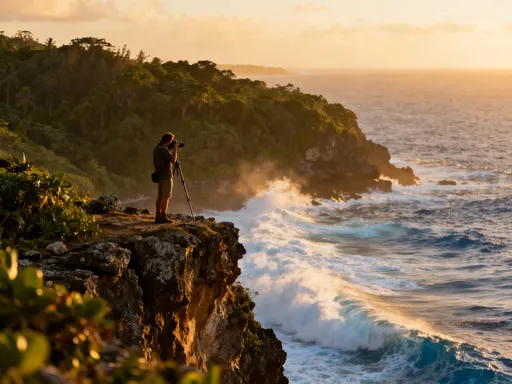
The cliffs near Piti are particularly striking. From the overlook, you can see the full power of the Pacific—waves crash against the rock with a deep, resonant boom, sending plumes of spray high into the air. The contrast between the dark, pitted rock and the frothy white water creates a natural high-contrast scene, perfect for black-and-white conversions. I recommend a wide-angle lens here to emphasize scale—include a small figure in the frame to show just how vast and imposing these formations are.
Winter months bring the most dramatic action. When the northern swells arrive, usually between December and March, the ocean transforms. Waves can reach 15 feet or more, hurling themselves against the cliffs with raw energy. This is the time for long exposures—set your shutter to several seconds, and the chaos of the waves becomes a smooth, ethereal mist. The effect is surreal, as if the ocean has turned to vapor. A sturdy tripod and remote shutter release are essential, as even the slightest vibration can blur the image.
Safety is paramount. These areas have no guardrails, and the rock can be slippery, especially after rain. I always check tide charts before visiting—some spots are only accessible at low tide, and getting cut off by rising water is a real risk. I’ve learned to go with a partner, wear sturdy shoes, and never turn my back on the ocean. The power of the sea here is humbling, and respect for it is non-negotiable.
One of my most memorable shots was taken at dawn on a winter morning. The sky was overcast, casting a cool, even light over the scene. A series of waves rolled in, one after another, each larger than the last. I used a 30-second exposure, and the resulting image shows the water as a seamless, glassy sheet rising toward the cliff, frozen in mid-impact. It’s not a realistic depiction of motion—but it captures the feeling of power and inevitability that defines this place.
The Magic of Micro-Moments
While grand landscapes draw the eye, it’s often the smallest details that stay with you. A single hermit crab crawling across wet sand. A spiderweb glistening with dew at sunrise. The way storm clouds gather over the horizon, purple and heavy with rain. These micro-moments, fleeting and easily missed, are the soul of photographic storytelling. They don’t require special gear or perfect light—just attention.
I’ve learned to slow down, to walk without a destination, to stop not because I see something, but because I feel a shift in the air. On a quiet morning near Inarajan, I crouched beside a tidal pool no larger than a dinner plate. Inside, a tiny fish darted between coral fragments, its colors iridescent in the morning light. I used a macro lens, focusing manually to get every scale sharp. The resulting image is small in scale but immense in detail—a universe in a puddle.
These moments also teach composition. A single shell on wet sand becomes a study in texture and contrast. A patch of moss on a rock becomes an abstract pattern. The key is to isolate the subject, eliminate distractions, and let the light do the work. Often, the best tool isn’t a lens, but a change in perspective—getting low, shooting from the side, waiting for a shadow to fall just right.
Storytelling matters as much as technique. A photo of a storm cloud isn’t just about weather—it’s about anticipation. A shot of a rice field at dawn isn’t just about agriculture—it’s about quiet labor, about cycles of growth and harvest. These images connect us to place not through spectacle, but through intimacy. They remind us that beauty isn’t always loud or vast—it can be small, quiet, and deeply personal.
Respecting the Land While Shooting It
Beautiful photographs should never come at the cost of the places that inspire them. In Guam, where ecosystems are fragile and cultural heritage is deeply respected, ethical photography isn’t optional—it’s essential. This means more than just following rules; it means approaching the island with humility and care.
Stay on marked trails. Avoid trampling native plants like the ifil tree or the endangered mahya fern. Never remove natural objects—shells, rocks, or plants—even if they seem insignificant. These are part of a larger system, and their removal can have ripple effects. When photographing wildlife, maintain distance. Use zoom lenses rather than approaching nests or resting animals. And always follow local guidelines—some areas are closed during nesting seasons, and drone use is restricted in many zones to protect both nature and privacy.
But respect goes beyond rules. It’s in the way you move through a place—quietly, thoughtfully, with gratitude. I’ve started leaving time at the end of each shoot just to sit and absorb, without lifting my camera. That practice has deepened my connection to the island and sharpened my intention behind every shot. When I do press the shutter, it’s not out of habit, but out of purpose.
Photographing Guam has changed how I see the world. It’s taught me that beauty isn’t just something to capture—it’s something to protect. And when we share these images, we carry a responsibility: to inspire not just wanderlust, but stewardship. Let your photos tell a story of wonder, yes—but also of care. Because the wild beauty of Guam isn’t just a backdrop. It’s a living, breathing world—and it deserves to be seen, and preserved, for generations to come.